Research
Overview
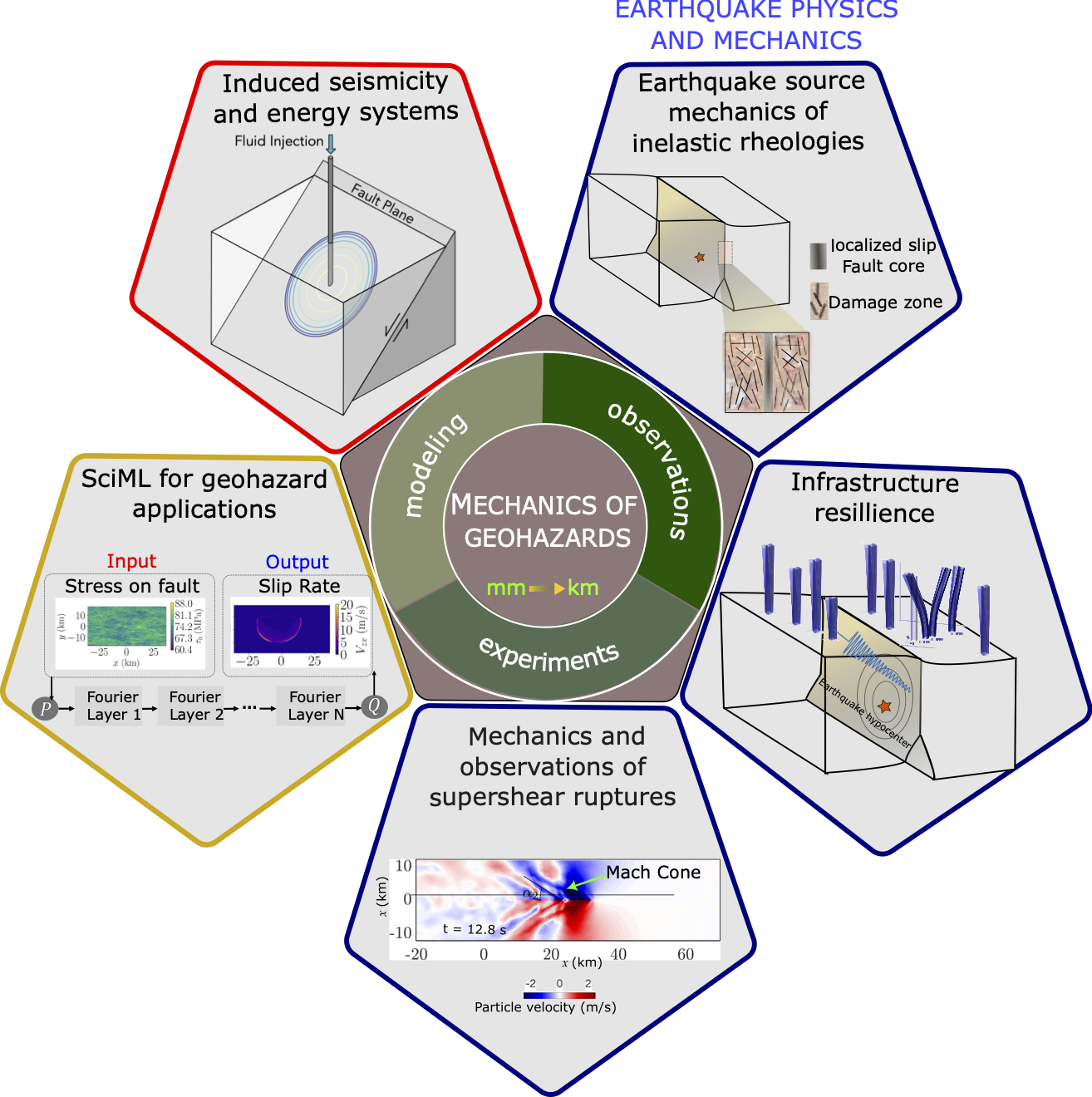
We couple geomechanics and geophysics to understand geohazards and subsurface processes across length and time scales, from mm to km and from quasi-static processes to rapid dynamics. Our work is grounded by observations that inform experiments, which in turn guide high-fidelity modeling.
Earthquake Physics and Mechanics
We study earthquake mechanics through multi-physics modeling and laboratory experiments to understand stable-to-unstable transitions, rupture arrest and cascading events, as well as the evolution of fault zone structure.
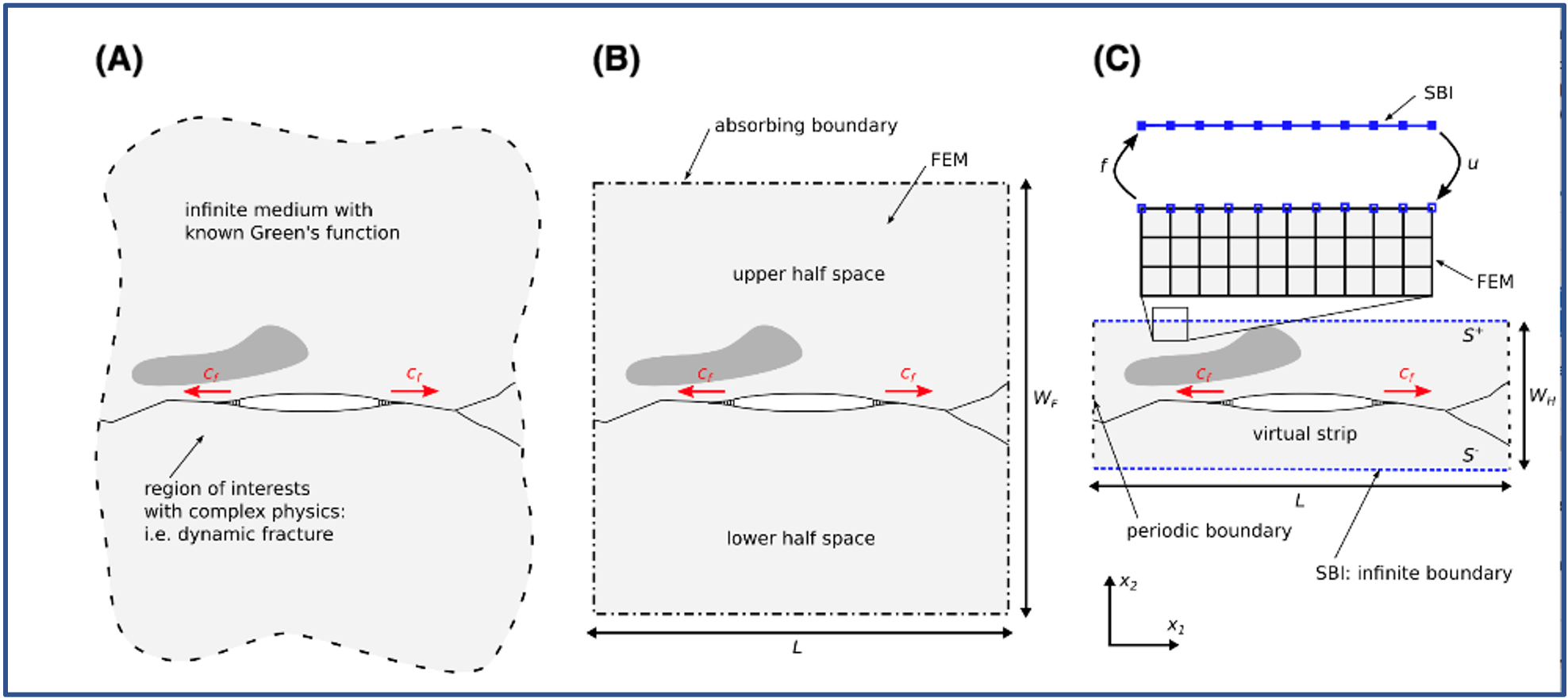
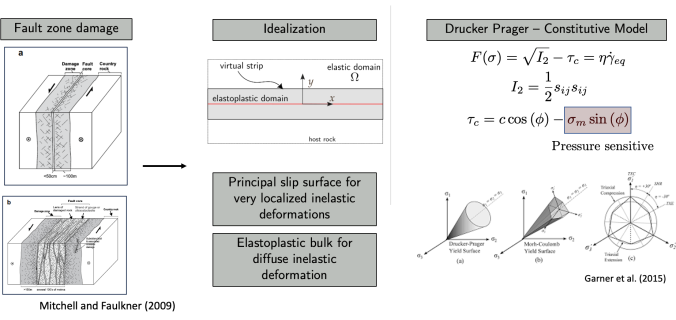
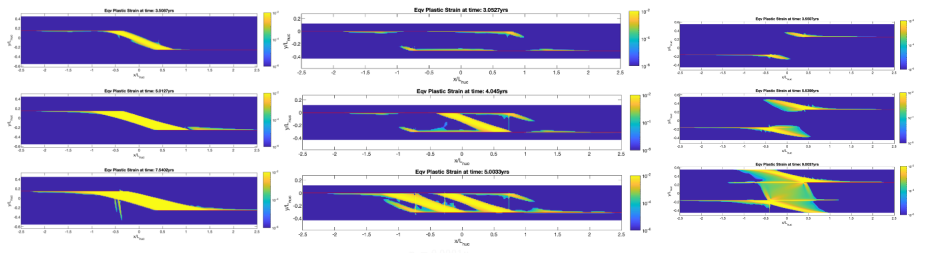
Through the development of FEBE, we modeled the evolution of fault zones with high-resolution physics based on observations. This includes pre-existing damage, low velocity fault zones, evolving damage, and plasticity. These mechanisms help explain coevolution between the surrounding fault zone and principal slip surfaces.
Dynamics of Delayed Triggering
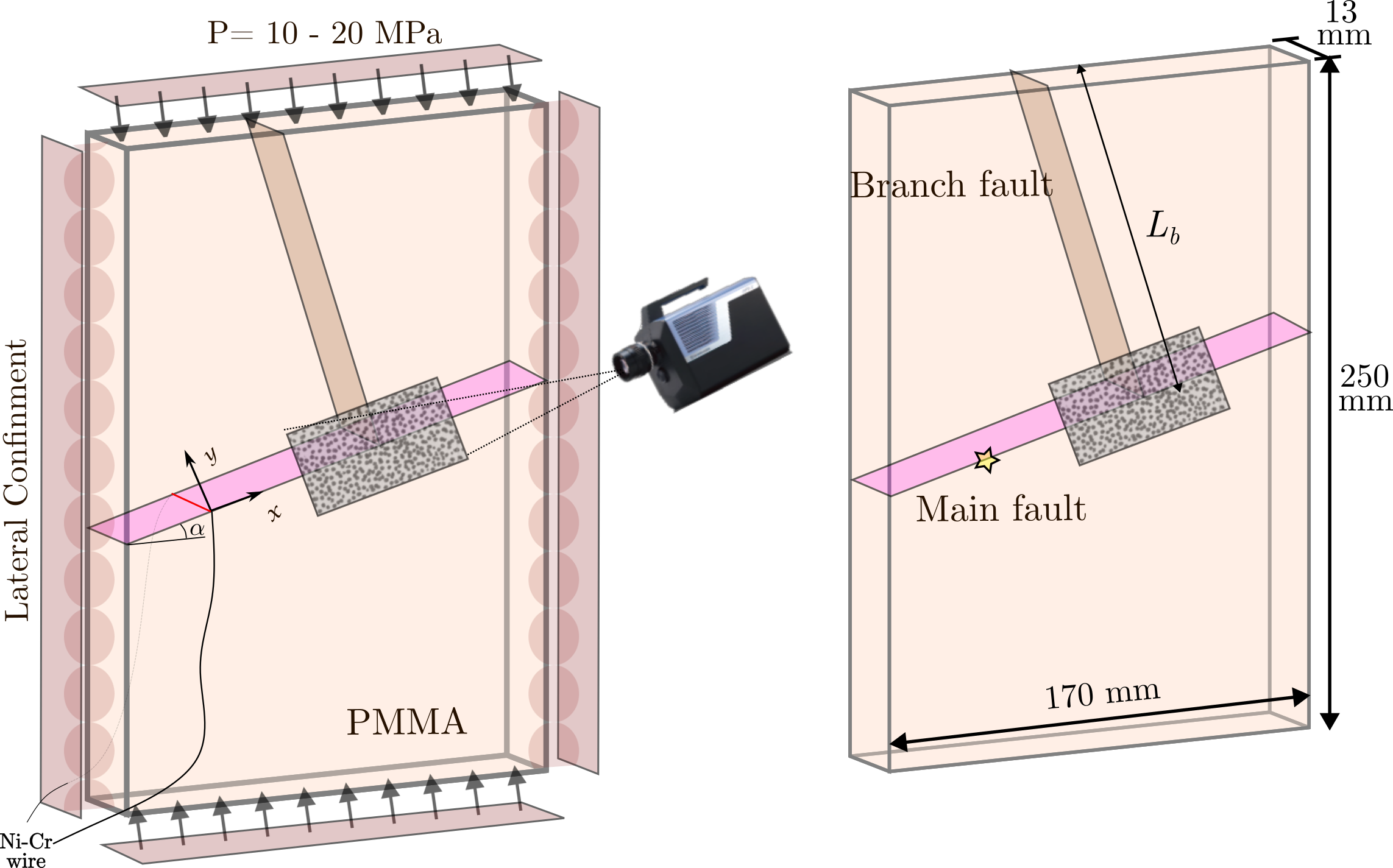
We experimentally study how fault branches act as stress barriers that can delay rupture propagation.
Supershear Ruptures
Rupture speed strongly affects ground motion. We study how subshear and supershear ruptures differ, when supershear transition occurs, and why those dynamics matter for seismic hazard.
Tsunamigenesis
By combining dynamic rupture models with the nonlinear shallow water wave equation, we studied mechanisms by which strike-slip earthquakes can induce tsunamis despite limited vertical displacement.
Fluid Induced Instabilities
We study the nucleation of fluid induced instabilities in fault zones. We seek to understand the role of interface healing and injection rate on instabilities that can lead to earthquakes, while complementing experiments with numerical modeling.
SciML for Geohazards
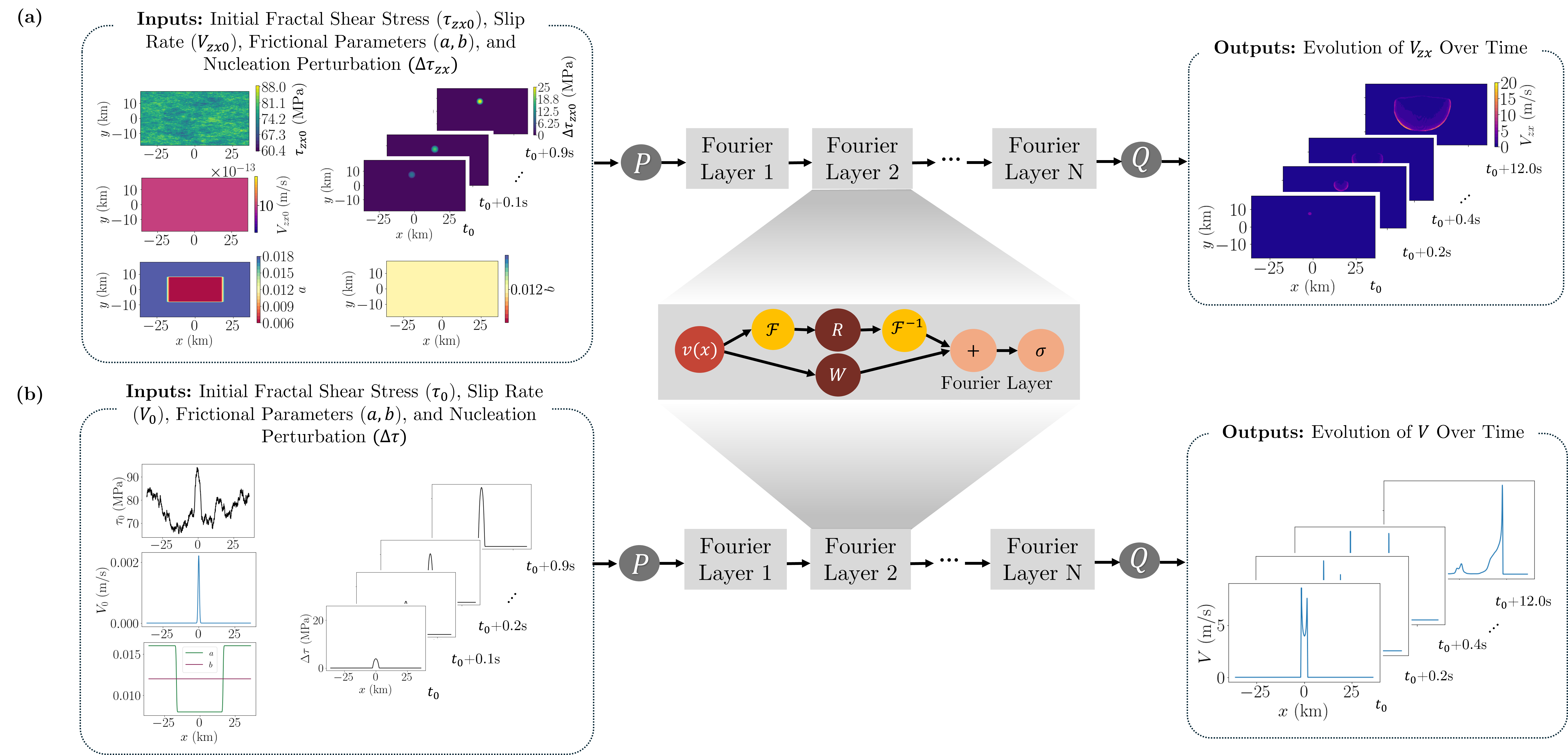
Many geohazard problems involve parameter spaces that are intractable to explore with traditional methods alone. We are developing machine learning models that accelerate numerical simulations and create opportunities for uncertainty quantification.
In recent work, we developed a Fourier Neural Operator model that predicts slip rate evolution from initial shear stress and frictional parameters with a speedup of 10000x relative to the fastest forward model.